Raffaella Regina
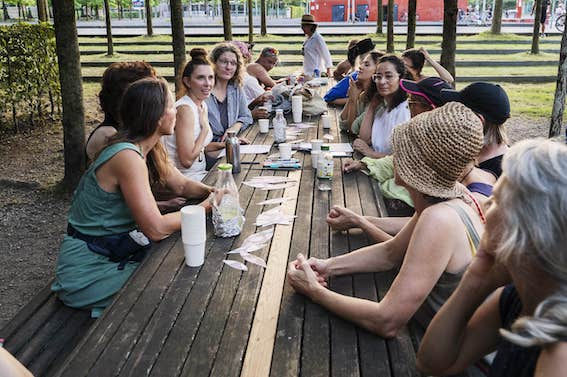
The first Zurich edition of MUJIMA was developed with the participation of Anastasia Gornacki, Raja Rezgui, and Antije Söllner.
Ph: Elzbeth Iten
Mujima
MUJIMA is an ongoing artistic research project in public space focused on migration, visibility, care work, motherhood, and the resignification of urban space. It began in 2024 in the Hirzenbach neighbourhood of Zurich, where I live, and took shape for the first time through a public action developed in the context of the festival PERFORMANCE REIHE NEU OERLIKON 15. The project emerged from a local context in Zurich and from a broader artistic practice connected to action in public space, collective presence, and the possibility of transforming everyday urban environments through artistic intervention.
At the centre of MUJIMA are migrant women, especially women raising children on their own, whose labour, movement, and forms of care are essential to the life of the city and yet often remain socially, politically, and symbolically invisible. The project does not seek to speak about them from the outside, nor to turn their experience into representation alone. Instead, it develops a situated artistic process with them, creating the conditions for gestures, memories, words, and forms of collective presence to emerge in public space. In this sense, MUJIMA understands art not as illustration, but as activation: a way of opening space for visibility, listening, recognition, and resignification.
The project combines artistic research, situated listening, shared reflection, bodily and spatial practices, and the collective development of a public action. The final form of each action is not fixed in advance, but grows out of the specific context, the people involved, and the relationships built during the process. A central aspect of the work is the symbolic remuneration of the participating women, as a way of recognising their time, their experience, and their active contribution to the artistic process. This ethical and artistic choice is fundamental to the project, because it affirms that participation is not an extractive gesture but a shared form of work and presence.
MUJIMA is conceived as a long-term artistic research project that can move across different urban and cultural contexts while remaining rooted in concrete local realities. After its first development in Zurich, the project now enters a new phase through the SACO RESIDENCY IN ANTOFAGASTA in Antofagasta, Chile (6 April – 5 May 2026), where it will continue in dialogue with migrant women in a Latin American context marked by border dynamics, care work, precariousness, and complex forms of belonging. Antofagasta is not a separate chapter but part of a broader artistic investigation that will continue to develop in the coming years, asking how artistic action can create new forms of visibility, collective presence, and resignification in the spaces we inhabit.